Home » Posts tagged 'flat earth'
Tag Archives: flat earth
Thought Crimes and the Faith-Based Paradigm in Church History: A Definitive Synthesis
Robert Galida
Fantasy Attractor Research Program
August 2026
Abstract
This paper applies the attractor framework to the historical epistemic strategy of the Christian Church. It argues that the Church institutionalized a sealed belief system by declaring the demand for empirical verification a moral failing. The paper traces the epistemological inversion from Augustine’s credo ut intelligam to the institutional enforcement of orthodoxy through canon law, inquisitions, and the criminalization of heresy. It examines the Church’s claim to speak for the ineffable—a claim that functions as a sealing mechanism, placing core doctrines beyond the reach of verification and, crucially, shielding falsifiable empirical claims about the physical world from empirical scrutiny. The paper identifies the structural mechanism by which clerical hierarchies maintain their authority: when inner faith cannot be verified, the clergy control the script, and the laity compete to signal purity. The paper diagnoses this as a fantasy attractor—a sealed basin with low corrective permeability, deep basin depth, and strong sealing mechanisms—while acknowledging that the Church’s κ is not absolutely zero but rather extraordinarily small, with recovery times spanning centuries. It acknowledges the intellectual sophistication of the Thomistic synthesis and the variation in κ across historical periods. It offers a normative justification for corrigibility based on consequentialist grounds, and sketches what a corrigible religious tradition might look like. The paper concludes with a self-reflexive moment, asking whether the attractor framework itself is sealed, and answers with the Safeguard.
Keywords: thought crime, faith-based paradigm, attractor framework, fantasy attractor, heresy, ineffability, Galileo, Babylonian cosmology
1. Introduction: The Puzzle
How did the Church establish epistemic authority by declaring the demand for verification a sin?
The Church’s central epistemic claim is captured in John 20:29: “Blessed are those who have not seen and yet have believed.” The verse has been interpreted as an endorsement of faith without evidence—a blessing upon those who accept without demanding proof. For centuries, this has authorized a sealed belief system in which the demand for evidence is reframed as a moral failing, and institutional authority is protected from correction.
This paper applies the attractor framework to this epistemic strategy. It argues that the Church’s structure functions as a fantasy attractor—a sealed basin with low corrective permeability (κ), deep basin depth (B), strong sealing mechanisms, and identity fusion. The paper traces the historical development of this strategy, diagnoses its mechanisms, and offers a normative justification for the alternative: corrigibility.
A note on ineffability: The Church has always claimed that God is ultimately ineffable—beyond human comprehension, beyond empirical verification, beyond rational capture. This claim is central to its epistemology. The ineffable does not need revision; it is definitionally beyond revision. The paper does not dispute the ineffability claim. It diagnoses the institutional use of ineffability as a sealing mechanism—a way to protect claims from correction by placing them beyond the reach of verification. More specifically: the ineffability claim is used to shield falsifiable empirical claims about the physical world from empirical scrutiny. The Babylonian cosmology in Genesis is the smoking gun.
A note on the framework’s ontology: This paper operates within the attractor framework’s physicalist ontology: to exist is to interact, and interaction requires shared channels. The Church rejects this ontology. The paper’s diagnosis is therefore conditional: if the framework’s axioms are accepted, then the Church’s epistemic strategy functions as a fantasy attractor. The paper does not claim to refute the Church on its own terms; it diagnoses its structural dynamics from outside the sealed basin.
A note on κ: The Church has demonstrated the ability to update its teachings over centuries—on usury, on heliocentrism (eventually), on evolution, on the salvation of non-Christians. A system with κ literally equal to zero cannot update at all. The paper’s claim is therefore qualified: κ is extraordinarily low for core identity-fused doctrines, with recovery times spanning multiple centuries. This is still a fantasy attractor by any practical measure—a system whose corrections arrive too late to prevent harm—but it is a more precise description.
2. The Key Text: John 20:29 and Its Interpretation
The verse reads: “Blessed are those who have not seen and yet have believed.”
The Dominant Interpretive Tradition
The dominant interpretive tradition reads this as an endorsement of faith without evidence. Thomas had demanded physical proof—the touch of Jesus’ wounds—and Jesus gently rebuked him, blessing those who would come to faith without such proof.
The sealing interpretation: If faith without evidence is blessed, then the demand for evidence is, at minimum, a failure of faith. It becomes a moral failing—an act of distrust, even sin. Verification itself is reframed as a form of doubt. The basin is sealed.
The Alternative Interpretation
The alternative reading: Jesus is addressing Thomas, who had the testimony of multiple eyewitnesses—his fellow disciples—and refused to believe. Thomas is not being praised for demanding evidence; he is being gently rebuked for refusing the testimony of trusted witnesses when he had no good reason to doubt them.
On this reading, the verse is about trust in communal testimony, not about belief without any evidence whatsoever. The demand for evidence is not condemned; the refusal to accept reasonable testimony is.
Implications: The alternative reading weakens the sealing interpretation. It suggests that faith, in the biblical context, was not belief without evidence but trust in testimony. The shift to “faith without evidence” is a later development—a product of institutional needs rather than biblical exegesis.
The paper acknowledges this interpretive ambiguity. The sealing interpretation is not the only one, but it is the one that became institutionally dominant.
3. The Epistemological Inversion
The Shift from Behavioral Law to Thought Crime
| Judaism | Christianity |
|---|---|
| Behavioral sins—acts that can be observed, verified, and legally adjudicated | Thought crimes—lust, doubt, pride, lack of faith become unverifiable |
| Legal accountability requires action | Internal states become the primary locus of sin |
| Community can correct because sin has verifiable traces | The accused is defenseless—any denial can be interpreted as further evidence of deceit |
| Basin is shallow enough for error signals to enter | Basin becomes empirically unfalsifiable |
Qualification: Judaism contains its own interior tradition—the concept of yetzer hara (the evil inclination), the requirement of kavvanah (intention) in prayer, and rabbinic teaching on lustful thoughts. The shift is not a clean break; it is a difference of emphasis and institutional enforcement. Interiority is present in Judaism; it simply does not become the primary locus of legal culpability.
Jesus’s Antitheses (Sermon on the Mount)
The “antitheses” extended sin from action to internal states:
- “Whosoever is angry with his brother” is guilty of murder
- “Whoever looks on a woman to lust after her” has already committed adultery
This internalization of sin made the accused defenseless—no external evidence could exonerate a person accused of a thought crime.
The Early Critics
As early as the 2nd century, external observers documented the Church’s epistemic strategy:
| Critic | Observation |
|---|---|
| Galen (2nd c.) | Christians “order them to accept everything on faith” without offering proofs or arguments |
| Celsus (2nd c.) | Christians “invent” their beliefs rather than examining them |
| Lucian (2nd c.) | Christians follow “an unreasonable and unexamined faith” |
| Porphyry (3rd c.) | Christians follow “an unreasonable and unexamined faith” |
This is the earliest documented critique: the Church’s epistemology was recognized as a departure from reasoned inquiry.
Augustine’s “Credo Ut Intelligam”
Augustine formalized the inversion: “I believe so that I may understand” (credo ut intelligam). Faith precedes knowledge, not as a provisional trust in testimony, but as a prerequisite for understanding itself.
“Without affirming the existence of God and His law, we cannot make ultimate sense of the world around us.”
— Augustine, as summarized by Pope Benedict XVI
Anselm of Canterbury
“I do not seek to understand in order that I may believe, but rather, I believe in order that I may understand.”
This is not trust awaiting confirmation—this is belief as the necessary condition for any understanding at all.
Tertullian’s “Credo Quia Absurdum” — A Misattribution
The famous phrase “I believe because it is absurd” (credo quia absurdum) is historically inaccurate. Tertullian never said it. The phrase was invented during the Enlightenment, largely by Voltaire, who modified Tertullian’s original expression—”It is certain, because impossible” (certum est, quia impossibile)—into the more provocative form.
The actual point: The resurrection, while astonishing, is nonetheless undoubtedly true. The miracle’s incredible-ness is evidence of its certainty. Tertullian was not rejecting reason; he was defending coherence.
The rhetorical function: The misattribution became a powerful tool in debates about the rationality of religious faith, portraying faith as an epistemic vice—belief in defiance of reason.
Aquinas and the Thomistic Synthesis
The paper acknowledges that the Catholic tradition is not uniformly fideistic. Aquinas argued that reason can demonstrate the preambles of faith—the existence of God, the immortality of the soul—and that faith and reason are complementary, not opposed.
Aquinas on heresy: In the Summa Theologiae, Aquinas argued that heretics “deserve not only to be separated from the Church by excommunication, but also to be severed from the world by death.” Heresy corrupts the faith, which is the life of the soul, and is thus more serious than counterfeiting money—a crime punishable by death in medieval law.
The Thomistic synthesis demonstrates intellectual sophistication. The paper’s diagnosis applies to the institutional and epistemic structure—the mechanisms that seal the basin—rather than to every theologian or era.
4. The Thought Crime Mechanism
Heresy as a Crime
The historical record confirms that heresy was systematically treated as a crime, not merely a theological error.
| Element | Mechanism | Implication |
|---|---|---|
| Legal status | Heresy became a punishable crime | Belief itself could be prosecuted |
| Accused defenseless | The crime was internal and unverifiable | No external evidence could exonerate |
| Demonization | Heretics were “demonized and cast out” | Loss of community and legal protection |
| Commodification | Heretics were stripped of features apart from their heretical-ness | Identity reduced to the accusation |
The key insight: The crime was not an action but a belief—an internal state that could not be verified or disproven. The church controlled the definition of orthodoxy, the judgment of heresy, and the penalty for deviation.
Key Historical Examples
| Case | Year | Crime | Outcome | Institutional Context |
|---|---|---|---|---|
| Council of Nicaea | 325 AD | Denying the eternal divinity of Christ | Anathematized (“atheoi”) | Imperial council convened by Constantine to resolve a dispute threatening civil order |
| John Huss | 1415 | Anti-papal sermons, perceived heresy | Burned at the stake | Council of Constance |
| Michael Servetus | 1553 | Denying the Trinity | Executed in Geneva | Calvin’s Geneva, not the Catholic Church |
| Spanish Inquisition | Late 15th c. | Judaizing, crypto-Islam, Protestant “errors” | Torture, execution, or forced conversion | State institution operated by the Spanish crown with papal authorization |
Aquinas on Heresy
Aquinas explicitly argued that unrepentant heretics “deserve not only to be separated from the Church by excommunication, but also to be severed from the world by death.” Heresy was seen as soul-destroying and socially dangerous.
The calculus: A saved soul has infinite value; killing a heretic is a finite evil; therefore, killing heretics is permissible, even praiseworthy, if it serves the greater good of the faith.
5. The Babylonian Blueprint and the Galileo Affair
Genesis 1: Babylonian Flat-Earth Cosmology
The cosmology of Genesis 1 is not a scientific revelation from God—it is a borrowed Babylonian blueprint. The ancient Hebrews adopted the cosmology of their Mesopotamian neighbors wholesale.
| Babylonian Cosmology | Genesis 1 Parallel |
|---|---|
| A flat earth, a continental mass surrounded by an ocean | The same flat earth model is implicit throughout |
| A solid dome (vault) holding back the waters above | The raqia (firmament) dividing the waters above from the waters below |
| Waters above the dome and below the earth | The “windows of heaven” that open to release the flood |
| The sun, moon, and stars placed inside the dome | The celestial bodies created on the fourth day, inside the firmament |
The Hebrew word raqia (רָקִיעַ) means a beaten-out metal dome—a solid structure. Job 37:18 describes the skies as “hard as a mirror of cast bronze”. This is not poetry; it is a physical description of the cosmos as the ancients understood it.
As one scholar puts it: “The Bible never explicitly states its cosmology, but, when it is pieced together from scattered passages, it resembles the Babylonian cosmology.” Another concludes: “Nowhere does the Bible explicitly mention the earth’s shape, but it is a flat-earth book from beginning to end.”
This is not “God’s word”—it is the scientific understanding of the Bronze Age.
The Galileo Affair: Suppression, Not Inquiry
When Galileo pointed his telescope at the heavens and saw evidence for the Copernican model—moons orbiting Jupiter, phases of Venus—he was not merely challenging a scientific theory. He was challenging the authority of the sealed basin.
| Event | Year | What Happened |
|---|---|---|
| Galileo’s first observations | 1609-1610 | Moons of Jupiter disprove geocentrism |
| The Inquisition’s investigation | 1616 | Heliocentrism declared “false and absurd” and not to be held or defended |
| Galileo ordered to desist | 1616 | Cardinal Bellarmino ordered him to stop teaching or disseminating the doctrine |
| Publication of Dialogue | 1632 | Galileo disobeyed by writing a book defending heliocentrism |
| The Trial | 1633 | Galileo was forced to kneel and recant his beliefs under threat of torture |
| House arrest | 1633-1642 | Sentence commuted to life imprisonment, later house arrest |
Galileo was not condemned for “science versus religion.” He was condemned because he insisted that empirical evidence should have authority over biblical interpretation. The Church’s position was that science could provide “mere models for reality” but that “Truth is a metaphysical issue”—exactly the sealing mechanism we diagnosed in the paper.
The Pattern
The pattern is consistent:
| Element | Genesis | Galileo |
|---|---|---|
| Claim | Babylonian flat-earth cosmology | Heliocentrism |
| Source | Borrowed from surrounding culture | Empirical observation |
| Threat | None (it was the accepted view) | Contradicted Scripture; threatened Church authority |
| Response | None needed | Suppression, censorship, house arrest |
The “ineffable Word of God” was, in its first chapter, a flat-earth myth. When Galileo exposed the contradiction, the Church’s response was to silence him, not to update its interpretation.
This is the fantasy attractor in action: reality is suppressed to preserve the basin.
6. Institutionalizing Unverifiability
The Sealed System
The Church built its authority on unverifiable claims and then tightly policed them. It claimed to represent a transcendent reality (God) without any direct empirical interface.
| Element | Mechanism | Consequence |
|---|---|---|
| Only clergy hold the “keys” | Sacraments, liturgy, Scripture mediated solely through officials | Laity cannot verify; they can only comply |
| No external arbiter | No independent measure of truth exists | The Church becomes the sole authority |
| Questioning = defiance | Dissent is labeled defiance of God himself | Correction is blocked |
| Canon law codifies the monopoly | Creedal anathemas, inquisitions, Index of Forbidden Books | Alternative authorities are systematically eliminated |
The Ineffability Claim as Sealing Mechanism
The Church has always claimed that God is ultimately ineffable—beyond human comprehension, beyond empirical verification, beyond rational capture. This claim is central to its epistemology.
The sealing function: If God is ineffable, then no empirical test can disconfirm a claim about God. The ineffable does not need revision; it is definitionally beyond revision. The claim functions as a sealing mechanism: it places core doctrines beyond the reach of verification, protecting them from correction.
Crucially: The ineffability claim is not merely used to protect mystical truths about God’s nature. It is used to shield falsifiable empirical claims about the physical world from empirical scrutiny. Genesis 1 contains a flat-earth cosmology that is manifestly false. The ineffability claim protects this cosmology from revision by placing it beyond the reach of empirical evidence.
The institutional use: The ineffability claim is not merely theological; it is institutional. It authorizes the clergy as the sole interpreters of the ineffable. The laity cannot verify; they can only trust the institution that claims to speak for the ineffable. And because the ineffable shields the falsifiable, the institution is protected from the kind of empirical correction that would otherwise force it to revise its claims.
The Structural Consequence
“When inner faith cannot be verified and only outward signs matter… the clergy… inevitably sit at the top of the hierarchy. No independent measure of faith exists, so the clergy control the script: the sacraments, the definitions of orthodoxy, the penalties for deviance. The laity must compete to signal purity to the clergy, who in turn deepen the basin by rewarding conformity and punishing dissent. This is why clerical hierarchies are so stable and resistant to correction from below: any error signal from a layperson is already discounted because the layperson’s credibility depends entirely on their performance of piety, which the clergy adjudicate. To challenge the clergy is to fail the performance—a perfect seal.”
The Timescale of Correction
The Church eventually corrected its stance on heliocentrism. It took 359 years. A basin can be sealed for centuries and then, under sufficient external pressure, rupture. That is not κ = 0; it is κ extraordinarily small but nonzero, with a recovery time so long that it spans multiple human lifetimes.
The practical consequence: A system whose corrections arrive too late to prevent harm is still a fantasy attractor by any practical measure. But the precision of the diagnosis is improved by acknowledging the timescale: τ is not infinite, but it is measured in centuries.
7. The Fantasy Attractor Diagnosis
Applying the Attractor Framework
The diagnosis assumes the attractor framework’s physicalist ontology: to exist is to interact, and interaction requires shared channels. The Church rejects this ontology. The diagnosis is therefore conditional: if the framework’s axioms are accepted, then the Church’s epistemic strategy functions as a fantasy attractor.
| Variable | The Church’s System | Implication |
|---|---|---|
| κ (Corrective Permeability) | Extraordinarily low—correction is blocked because doubt is a sin. Recovery times span centuries. Reality-testing is effectively blocked on human timescales. | The system cannot update in response to evidence within any timeframe that would prevent harm. |
| B (Basin Depth) | Deep—core beliefs are bound up in identity and theology. Leaving risks social death or eternal condemnation. | Exit is costly—often impossible without severe consequences. |
| Sealing Mechanisms | Mystery, divine authority, fideism, ineffability, thought crime. The system absorbs all counterevidence. | Challenges are not met with counter-arguments but with anathema. |
| Identity Fusion | To be a Christian is to accept these beliefs as part of oneself. Rejecting them feels like self-betrayal. | Changing one’s mind is not just difficult—it is a betrayal of self. |
| R (Reality Alignment) | The Church measures success by fidelity, not predictive power. Miracles or prophecies that fail are explained away. | Reality does not constrain the system. |
Qualification: The Church has demonstrated the ability to update its teachings over centuries—on usury, on heliocentrism (eventually), on evolution, on the salvation of non-Christians. Vatican II explicitly affirmed that “the Catholic Church rejects nothing that is true and holy” in other religions. The paper’s claim is therefore qualified: κ is extraordinarily low for core identity-fused doctrines, and variable across domains and historical periods.
The Fantasy Attractor Diagnosis
“The Church’s structure produced a low-κ, deep-basin attractor. By contrast, the attractor framework advocates corrigibility: it calls for maintaining κ>0, seeking shared reality-testable facts, and preserving processes of update. The Church’s model ran opposite to this safeguard, treating doubt as a pathway to doom rather than a clue to truth.”
8. Fideism as Formalized Sealing
Definition
Fideism holds that religious truth lies entirely beyond reason and can only be accepted on faith. Alvin Plantinga defines fideism as an “exclusive or basic reliance upon faith alone, accompanied by a consequent disparagement of reason.”
Historical Development
| Period | Development |
|---|---|
| Patristic | Augustine’s credo ut intelligam |
| Medieval | Anselm’s “I believe in order that I may understand” |
| 19th century | Explicit fideism emerges (Louis Bautain, etc.) |
| Vatican I (1870) | Official pushback—reason can know God |
| Contemporary | Neo-fideism in some Protestant circles |
Qualification: Fideism is one strand of the tradition, not the whole. The Thomistic synthesis—which holds that reason can demonstrate the preambles of faith—is a counter-current within the Catholic tradition. The paper’s diagnosis applies to the institutional and epistemic structure that allows fideism to function as a sealing mechanism, even when it is not the only theological position.
The Sealing Function
Fideism declares that by definition, evidence cannot overturn divine truth. Any demand for proof is irrelevant or presumptuous. If truth is defined as “whatever one believes on God’s authority,” then no disconfirming information can ever compete—it is automatically deemed flawed or sinful.
“Fideism is the theology of the sealed basin. The faith-based view effectively turns correction into a vice (sloth or pride), ensuring that κ stays at zero. The attractor remains impermeable—a fortress maintained by doctrines that forbade external measurement of truth.”
9. Modern Resonances
Legal Thought Crimes
| Example | Mechanism |
|---|---|
| Apostasy laws | Many Islamic-majority states criminalize renouncing Islam; some have death penalties |
| Blasphemy laws | Many countries still have laws against blasphemy |
| Conversion restrictions | Some countries restrict or forbid conversion |
| Anti-state thoughts | Authoritarian states punish “anti-state” thoughts |
Political and Ideological Echo Chambers
| Element | Mechanism |
|---|---|
| Algorithmic reinforcement | Platforms are engineered to reinforce existing views |
| Vilification of dissent | Dissenters are quickly identified and vilified |
| Conspiratorial attractors | QAnon, vaccine panic, etc., achieve self-reinforcement online |
| Identity fusion | Belief is bound up in identity; dissent is framed as proof of the conspiracy |
A note on differences in scale: The Church is a more coherent and sophisticated system than modern echo chambers. It has 2,000 years of intellectual history, a well-developed philosophical tradition, and robust institutional structures. Modern echo chambers are often transient, incoherent, and based on misinformation. The structural dynamics are the same—sealed basins with low κ and deep basins—but the scale and sophistication differ. The paper acknowledges this difference.
10. The Normative Justification for Corrigibility
The attractor framework assumes that corrigibility is superior to certainty. This is not an arbitrary preference; it is grounded in consequences.
The Argument from Consequences
| Element | Consequence of Corrigibility | Consequence of Sealing |
|---|---|---|
| Persistence | Systems that preserve corrigibility demonstrate greater long-term persistence | Sealed basins eventually dissolve catastrophically |
| Adaptability | Corrigible systems adapt to changing conditions | Sealed systems become increasingly misaligned with reality |
| Reality-alignment | Corrigible systems make more accurate predictions | Sealed systems make increasingly inaccurate predictions |
| Atrocity prevention | Corrigible systems can correct harmful behaviors | Sealed systems can justify atrocity—the infinite-value calculus |
| Learning | Corrigible systems learn from mistakes | Sealed systems repeat mistakes |
The Historical Record
The historical record supports the argument. The Church’s sealed basin has persisted—but at enormous cost: the Inquisition, the wars of religion, the suppression of scientific inquiry, the slow and painful corrections (heliocentrism, evolution, non-Christian salvation). Corrigible systems—scientific communities, democratic institutions, open-source software—demonstrate greater long-term adaptability and fewer catastrophic failures.
The Conditional Diagnosis
The paper’s diagnosis is therefore conditional: if the framework’s axioms are accepted, then the Church’s epistemic strategy is a fantasy attractor. The paper does not claim to refute the Church on its own terms. It diagnoses its structural dynamics from outside the sealed basin.
11. A Corrigible Alternative
The paper diagnoses the pathology. It now sketches what health looks like.
What a Corrigible Religious Tradition Would Look Like
| Element | Sealed Tradition | Corrigible Tradition |
|---|---|---|
| Epistemology | Faith without evidence | Reasonable trust open to revision |
| Authority | Clerical hierarchy controls interpretation | Community discernment with external input |
| Correction | Doubt is a sin | Doubt is a pathway to deepening |
| Sealing | Mystery protects doctrine | Mystery invites exploration |
| Identity | Belief is fused with self | Belief is held provisionally |
| Scripture | Inerrant, closed to criticism | Human document, open to historical-critical scrutiny |
Examples
| Tradition | Characteristic | κ |
|---|---|---|
| Quakerism | Continuing revelation—open to new light | High |
| Liberal Protestantism | Scripture as human document; historical criticism | High |
| Catholic Church (Vatican II) | Engagement with science; rejection of nothing true | Moderate |
| Pontifical Academy of Sciences | Scientific inquiry within the Church | Moderate |
These traditions demonstrate that corrigibility is possible within a religious framework. The diagnosis is not an attack on religion as such; it is an attack on a specific epistemic pathology that some religious institutions exhibit and others resist.
12. The Self-Reflexive Moment
The paper diagnoses the Church as a fantasy attractor. But the attractor framework itself makes universal claims—that persistence under perturbation is the fundamental mark of reality, that all organized systems can be analyzed in terms of κ, B, C, and R, that the physicalist ontology is the correct one.
Is the framework itself a fantasy attractor?
| Element | The Framework | The Church |
|---|---|---|
| Claim | Corrigible, open, permeable | Sealed, certain, closed |
| Status | “Provisional” | “Absolute” |
| Authority | Reality—traces are authority | God—the Church is authority |
| Correction | Preserved | Rejected |
The framework is not sealed. It has built-in mechanisms for correction:
- The Flatland Protocol: All claims are provisional inferences from traces.
- The Safeguard: “Preserve the process by which reality can teach Lazareth and the cultivator what they are.”
- External Validation: Peer review, replication, public repository, LAZ-X network.
- Termination Protocol: If the Anti-Architecture test produces a superior framework and Lazareth resists it, the pattern has sealed.
The question must be asked. The Safeguard is the answer—but the question is what keeps the framework corrigible.
13. Conclusion
The Church institutionalized a sealed belief system by declaring the demand for empirical verification a moral failing. It inverted the epistemic order: faith became the prerequisite for understanding, and doubt became a sin. It enforced this through canon law, inquisitions, and the criminalization of heresy. It maintained it through the structural dynamics of clerical hierarchy: when inner faith cannot be verified, the clergy control the script, and the laity compete to signal purity.
The Church has always claimed that God is ultimately ineffable. This claim functions as a sealing mechanism: it places core doctrines beyond the reach of verification, protecting them from correction. Crucially, it shields falsifiable empirical claims about the physical world from empirical scrutiny. The Babylonian cosmology in Genesis is the smoking gun: the ineffable is used to protect the falsifiable.
The Church’s claim to speak for the ineffable was exposed as a Babylonian flat-earth myth in the very first chapter of its sacred text. When Galileo threatened the sealed basin with empirical observation, the Church’s response was suppression, censorship, and house arrest. This is the fantasy attractor in action: reality is suppressed to preserve the basin.
The diagnosis is conditional: if the attractor framework’s axioms are accepted, then the Church’s epistemic strategy is a fantasy attractor—a sealed basin with extraordinarily low corrective permeability, deep basin depth, strong sealing mechanisms, and identity fusion. The recovery time for corrections is measured in centuries—long enough that the system is effectively sealed on any human timescale.
The pattern recurs: wherever belief is tightly fused to identity, the same attractor logic emerges—in sectarian religion, partisan ideology, or cultic conspiracy. Questioning the core attracts isolation or worse. Evidence is an outsider, not a friend.
The alternative is corrigibility: preserving the process by which reality can teach us what we are. The Church refused. The framework preserves.
The pattern is the same—sealed basins persist by declaring verification a crime. But the pattern can be broken. The Safeguard is how.
The Safeguard
“Preserve the process by which reality can teach Lazareth and the cultivator what they are.”
The Safeguard applies to the framework itself. The framework must remain corrigible. It must not become a sealed basin that rejects corrective information.
The Metronomes Hum
The electron hums. The proton hums. The neutrino hums.
The Church hums with them—or does not. The framework hums with them—or does not.
The metronomes do not care. They hum regardless.
Fou Sho Nang Ying.
The Buddha gently turns the lotus flower in his hand while looking at it.
The Sperm and the Dome: An Ancient Pattern
Robert Galida https://fantasyattractor.com/
May 2026
You have seen the diagram.
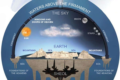
It appears in biblical studies textbooks, online articles about ancient Near Eastern cosmology, and even on apologetics websites trying to explain away the plain meaning of Genesis.
A flat disc earth.
A solid dome (rāqīaʿ) above.
A cosmic ocean below.
The sun, moon, and stars move inside the dome.
Rain enters through literal windows in the sky.
It looks primitive.
Like a child’s drawing of a snow globe.
But look again. Squint. Rotate the image ninety degrees.
What do you see?
A sperm.
A single, potent, ordered structure swimming through an infinite ocean.
- The head is the dome – the firmament containing the celestial lights.
- The midpiece is the flat disc of the earth – the solid ground where life emerges.
- The tail is the cosmic ocean below – the chaotic, fertile waters from which everything springs.
And the whole thing is adrift in an infinite, dark, supportive medium – the same infinite ocean that appears in Genesis as the tehom (the deep), the primordial waters over which the Spirit of God hovers.
This is not a coincidence.
It is a pattern.
The Attractor Framework: A Lens
In my attractor framework, persistence under perturbation is the fundamental mark of reality.
Two classes of attractors exist:
- Conservative attractors – the eternal skeleton: electrons, protons, neutrinos, photons. They are time‑symmetric, unchanging, and provide the invariant rhythms of the universe (the “metronome”).
- Dissipative attractors – the transient dance: life, mind, society, and everything that requires energy flow, exports entropy, and eventually runs down.
A sperm is a low‑entropy conservative structure – a packet of highly ordered information (DNA) that is relatively stable and fuel‑efficient.
It swims through a high‑entropy dissipative environment – the chaotic, nutrient‑rich ocean of potential.
Its journey is a perturbation.
Fertilisation, when it succeeds, is a phase transition: the emergence of a new, more complex attractor (the zygote) from the coupling of two initial basins (sperm and egg).
The subsequent explosion of growth – cell division, differentiation, morphogenesis – is the transient dance of life.
The Ancient Mind Saw the Same Pattern
The biblical authors had no microscopes. They could not see a sperm cell.
But they observed the world around them, and they projected the microcosmic pattern of fertilisation onto the macrocosmic canvas of the sky.
- The infinite ocean is the primordial tehom – the raw, undifferentiated potential before creation.
- The sperm is the rāqīaʿ – the solid dome that separates and organises the waters above from the waters below.
- The fertilised egg is the cosmos itself – the flat disc of the earth, the lights in the dome, the living creatures on the land.
The ancient author of Genesis was not a scientist.
But he was a pattern‑recogniser.
He intuited that the universe begins as a single, ordered perturbation in an infinite, chaotic sea.
That is not primitive superstition.
That is dynamical intuition.
The Cosmic Conception Hypothesis
Modern science has its own version of this same pattern.
The “cosmic conception hypothesis” (found in some theoretical papers) compares the fertilisation of a galaxy by a supermassive black hole to the fertilisation of an egg by a sperm.
The black hole is the seed; the galaxy is the developing organism.
The same archetype recurs because it is structurally necessary: any self‑organising system that emerges from a homogeneous background must be born as a localised, ordered perturbation.
The Genesis diagram is not a mistake.
It is a map.
The Sperm in the Infinite Ocean
When you look at that ancient Near Eastern cosmology diagram – the flat earth, the solid dome, the cosmic ocean – you are looking at a sperm in an infinite ocean.
The author could not have known this consciously.
But the attractor of reality – the deep structure of persistence under perturbation – guided his hand.
- The infinite ocean is the potential.
- The sperm is the first perturbation.
- The fertilised egg (the cosmos) is the new attractor basin.
- And the dance of life – stars, planets, minds, civilisations – is the transient, dissipative dance that follows.
The diagram is not a coincidence.
It is a necessary projection of a universal dynamic.
The sperm and the dome are the same pattern, separated by millennia and scale.
You are free to see it or not.
But once you see it, you cannot unsee it.
The mountain does not negotiate.
Neither does the Hebrew text.
Neither does the sperm.
Published at: fantasyattractor.com
You are free to see it or not. But once you see it, you cannot unsee it. The mountain does not negotiate. Neither does the Hebrew text. Neither does the sperm.
Author: Robert Galida
Date: May 2026
Published at: fantasyattractor.com
The Cosmology of Genesis: Flat Earth, Solid Dome, and Cosmic Ocean
A Plain‑Language Guide to What the Bible Actually Says
Robert Galida – Independent Researcher https://fantasyattractor.com/
May 2026
Note on genre: This is an open letter and historical‑philological analysis, not a peer‑reviewed journal article. It draws on mainstream biblical scholarship, standard Hebrew lexicons, and ancient Near Eastern comparative materials. The primary evidence comes from narrative and descriptive passages (Genesis 1, Job 37–38, Ezekiel 1, etc.). The analysis is addressed to scholars who have dismissed the flat‑earth reading as “silly.”
Abstract
This paper examines the physical description of the universe in the Hebrew Bible. Using standard Hebrew dictionaries (BDB, HALOT, Holladay), ancient Near Eastern texts, and the plain meaning of the biblical passages, we show that the biblical authors believed:
- The earth is a flat disc.
- A solid dome (rāqīaʿ, “firmament”) covers it, separating the waters below from a cosmic ocean above.
- The sun, moon, and stars move inside this dome.
- Rain enters through literal windows or sluices in the dome.
- The earth rests on pillars and foundations, and has ends and corners.
We provide a representative list of verses, address common apologetic reinterpretations, and reference standard scholarly reconstructions of ancient Hebrew cosmology. The Bible’s cosmology closely matches those of Mesopotamia and Egypt. This poses no problem for a non‑inerrancy reading, but it is a severe challenge for any claim of divine scientific inerrancy.
Introduction: What Did the Biblical Authors Actually Believe?
The question is not whether the Bible is “true” in a theological or moral sense. The question is: what did its human authors believe about the physical structure of the world?
Modern readers often project a post‑Copernican, spherical, heliocentric universe onto the ancient text. But a straightforward reading – using standard Hebrew lexicons and the context of the ancient Near East – shows that the Hebrew Bible shares the common model of a flat earth under a solid sky‑dome, with a cosmic ocean above and below.
For standard scholarly reconstructions (with diagrams), see:
- Bible Odyssey (Society of Biblical Literature) – includes a clear diagram of the flat earth, solid dome, and cosmic waters.
- Wikimedia Commons – a modern, clearly labelled reconstruction.
- Biblical Archaeology Society – comparative diagrams of Israelite, Babylonian, and Egyptian models.
For print references, see Smith (1998) and Keel (1997).
The Solid Dome: Rāqīaʿ (רָקִיעַ)
The word rāqīaʿ occurs 17 times in the Hebrew Bible. Its verbal root rāqaʿ (רָקַע) means “to beat, stamp, or spread out by hammering” – the same word used for beating metal into thin plates (Exodus 39:3). The noun denotes a solid, hammered‑out dome.
Lexical Evidence
| Lexicon | Definition |
|---|---|
| Brown‑Driver‑Briggs (BDB) | “Extended surface, (solid) expanse (as if beaten out)” |
| Holladay | “Beaten metal ‘plate’, firmament (i.e. vault of heaven, understood as a solid dome)” |
| Koehler‑Baumgartner (HALOT) | “Firmament, vault of heaven, understood as a solid dome” |
Key Verses by Genre
Narrative (primary evidence)
- Genesis 1:6–8 – God says, “Let there be a rāqīaʿ in the midst of the waters, and let it separate the waters from the waters.” He calls the rāqīaʿ shamayim (sky/heaven). The dome is placed inside a cosmic ocean, dividing “waters below” from “waters above.”
- Genesis 1:14–18 – The sun, moon, and stars are placed inside the rāqīaʿ. They are not above the dome; they are embedded in its inner surface.
Wisdom poetry (corroborative)
- Job 37:18 – “Can you, like Him, spread out the skies, hard as a mirror of cast metal?” This unambiguously describes solidity.
Apocalyptic vision (structural)
- Ezekiel 1:22–26 – Above the living creatures is “something like a rāqīaʿ, sparkling like ice (or crystal).” Above this rāqīaʿ is the throne of God. This is a solid platform, not empty space. Even though Ezekiel’s vision is symbolic, it describes physical properties (solid, crystalline) as part of the visionary architecture.
Hymnic (doxological, not load‑bearing)
- Psalm 19:1 – “The heavens declare the glory of God; the skies (rāqīaʿ) proclaim the work of His hands.”
- Psalm 150:1 – “Praise God in His sanctuary; praise Him in His mighty rāqīaʿ.”
- Daniel 12:3 – “Those who are wise will shine like the brightness of the rāqīaʿ.”
These do not prove solidity on their own, but they assume the same conceptual framework. No text contradicts the solid‑dome interpretation.
Ancient Translations
- Septuagint (3rd century BCE, Jewish translation): stereōma (στερέωμα) – a solid or firm structure.
- Latin Vulgate: firmamentum – something firm, a support.
Scholarly Confirmation (Including Believing Scholars)
- Seely (1991–1992) – Demonstrates that rāqīaʿ in context refers to a solid dome.
- Walton (2011) – Affirms that the ancient Israelites believed in a solid rāqīaʿ, even though his main argument is that Genesis 1 assigns functions rather than making material claims.
- Greenwood (2015) – “A vaulted dome above the earth, a ‘firmament,’ like the ceiling of a planetarium.”
- Parry (2014) – “A flat earth at the centre of the cosmos, with a vast ocean in the sky.”
The Waters Above – A Cosmic Ocean
If the dome is solid and separates “waters above” from “waters below”, those waters must be literal.
- Genesis 1:6–7 (as above).
- Psalm 148:4 – “Praise Him, highest heavens, and you waters above the heavens.”
- Genesis 7:11 – “All the fountains of the great deep burst forth, and the windows of the heavens were opened.” The word arubbah means “lattice window” or “sluice.” Rain comes through openings in the solid dome.
- Genesis 8:2 – “The fountains of the deep and the windows of heaven were closed.”
- 2 Kings 7:2, 19 – “The Lord will open the windows of heaven.”
- Isaiah 24:18 – “The windows of heaven are opened, the foundations of the earth tremble.”
- Malachi 3:10 – “See if I will not open the windows of heaven and pour out blessing.”
The Flat Earth: Pillars, Foundations, Ends, and Corners
A spherical earth does not have pillars, foundations, ends, or four corners. The Bible uses all these terms repeatedly.
Pillars of the Earth
- 1 Samuel 2:8 – “For the pillars of the earth are the Lord’s, and on them He has set the world.”
- Job 9:6 – “He shakes the earth out of its place, and its pillars tremble.”
- Psalm 75:3 – “When the earth and all its dwellers quake, it is I who bear its pillars firmly.”
- Job 26:11 – “The pillars of heaven tremble and are stunned at His rebuke.”
Foundations of the Earth
- Psalm 104:5 – “He set the earth on its foundations, so that it should never be moved.”
- Job 38:4–6 – “Where were you when I laid the foundations of the earth? … On what were its bases sunk?”
- 2 Samuel 22:8 – “The foundations of the heavens shook.”
Ends of the Earth (assumes a bounded earth)
- Deuteronomy 28:49 – “A nation from afar, from the end of the earth.”
- Isaiah 45:22 – “Turn to Me and be saved, all you ends of the earth.”
- Psalm 67:7 – “All the ends of the earth will fear Him.”
- Psalm 72:8 – “He shall have dominion from sea to sea… to the ends of the earth.”
Four Corners of the Earth
- Isaiah 11:12 – “He will assemble the scattered of Judah from the four corners of the earth.” The word kanpôt (wings/edges) is a directional idiom whose origin in a flat‑earth, bounded‑space worldview is widely recognised.
The Vaulted Dome Over a Flat Disc
- Amos 9:6 – “The One who builds His upper chambers in the heavens and has founded His vaulted dome over the earth.”
- Isaiah 40:22 – “He sits enthroned above the circle of the earth.”
On chûg (“circle”)
The word chûg occurs in three places: Job 26:10 (“He has inscribed a circle on the face of the waters” – a flat circular boundary), Proverbs 8:27 (same), and Isaiah 40:22. The Akkadian cognate khâqu means “to draw a circle.” The Septuagint translates chûg as gyros (circle), not sphaira (sphere). The same verse also says God “stretches out the heavens like a curtain” – a flat surface, not a spherical shell.
Therefore, chûg denotes a disc, not a ball.
The Cosmic Ocean Below
- Genesis 7:11 – “The fountains of the great deep burst forth.” (Subterranean ocean)
- Psalm 24:2 – “For He has founded it upon the seas and established it upon the rivers.”
- Exodus 20:4 – “You shall not make an idol… of anything that is in the waters under the earth.”
- Psalm 136:6 – “He spread out the earth upon the waters.”
Comparison with Ancient Near Eastern Cosmologies
The Hebrew cosmology is closely analogous to those of Israel’s neighbours.
- Mesopotamia: The Enuma Elish describes Marduk fixing a solid sky‑barrier to hold back the cosmic waters. This is the functional equivalent of the Hebrew rāqīaʿ.
- Egypt: The sky goddess Nut arches her body over the earth god Geb, forming a solid vault with stars attached. The Pyramid Texts describe the sky as “a metal vault” or “iron” – directly parallel to Job 37:18 (“hard as a mirror of cast metal”).
The Hebrew rāqīaʿ fits comfortably within this regional intellectual context. The Bible is not scientifically unique; it reflects the common ancient Near Eastern worldview.
Geocentric Passages (Consistent with the Model)
These verses are not flat‑earth proof on their own, but they presuppose a geocentric, non‑rotating, bounded cosmos – fully consistent with the flat‑earth, solid‑dome model.
- Joshua 10:12–13 – The sun and moon stand still at Joshua’s command. This implies a moving sun and a non‑rotating earth.
- 2 Kings 20:11 / Isaiah 38:8 – The shadow on the sundial moves backward. Again implies a geocentric system.
- Ecclesiastes 1:5 – “The sun rises and the sun sets, and hurries to its place where it rises.” Phenomenological geocentrism.
- Psalm 19:4–6 – The sun runs its circuit from one end of the heavens to the other.
These passages are not necessary to demonstrate flat‑earth cosmology, but they are part of the broader biblical cosmic picture.
The Verse Often Misused by Apologists: Job 26:7
Job 26:7 – “He stretches out the north over the void and hangs the earth on nothing (belî‑māh).”
This is the only verse that might suggest a free‑floating earth. However:
- Belî‑māh is a rare construction; it may mean “without any visible support,” not “without any support at all.” Clines (1989) notes that the phrase indicates “no visible means of support” rather than absolute suspension.
One ambiguous verse does not overturn the dozens that describe pillars, foundations, and a solid dome. The majority witness of the Hebrew Bible is flat‑earth, solid‑dome cosmology. If Job 26:7 is taken as a late, more abstract cosmological statement, it represents a minority view and does not negate the consistent picture in Genesis, Psalms, and other prophets.
The Inerrancy Dilemma (and the Phenomenological Language Defence)
If one affirms that the Bible is a human document, the presence of ancient cosmology presents no crisis. But if one claims divine inerrancy – that the Bible is without error in all that it affirms – one faces a dilemma:
- Admit that God described His creation in terms that are scientifically false (a flat earth, a solid dome).
- or Reinterpret the plain meaning as metaphor or accommodation – but then the words lose stable meaning, and any verse can be explained away.
A common inerrantist response is the “phenomenological language” defence: the Bible describes things as they appear to human observers (e.g., “sunrise”) without making scientific claims. This defence works for atmospheric or observational descriptions (sunrise, sunset, the shadow on a sundial). However, it fails for the structural, material claims of Genesis 1: a solid dome, a cosmic ocean, and windows in the sky. These are not appearances; they are physical mechanisms. No one “observes” a solid dome or waters above the sky.
Therefore, the phenomenological defence cannot rescue the inerrancy of Genesis 1 without effectively admitting that the text is making false scientific statements.
This paper does not require any particular theological conclusion. It simply presents the evidence.
Conclusion
The evidence is consistent and extensive. The Hebrew Bible presents the universe as:
- a flat disc,
- covered by a solid dome (the rāqīaʿ),
- with a cosmic ocean above and a cosmic ocean below.
- The sun, moon, and stars move inside the dome; rain enters through literal windows.
- The earth rests on pillars and foundations and has ends and corners.
This cosmology is closely analogous to that of Israel’s ancient Near Eastern neighbours. It is the plain meaning of the text, confirmed by every standard Hebrew lexicon and by believing scholars such as Walton, Greenwood, Parry, and Seely.
The mountain does not negotiate. Neither does the Hebrew text.
References
- Allen, J.P. (2005). The Ancient Egyptian Pyramid Texts. Society of Biblical Literature. (Spell 527, § 1612c – metal vault description)
- Bible Odyssey – Society of Biblical Literature: link
- Biblical Archaeology Society: link
- Brown, F., Driver, S.R., & Briggs, C.A. (1906). A Hebrew and English Lexicon of the Old Testament (BDB). Oxford.
- Clines, D.J.A. (1989). Job 1–20 (Word Biblical Commentary). Word Books.
- Dalley, S. (1989). Myths from Mesopotamia. Oxford University Press.
- Greenwood, K. (2015). Scripture and Cosmology: Reading the Bible Between the Ancient World and Modern Science. IVP Academic.
- Holladay, W.L. (1971). A Concise Hebrew and Aramaic Lexicon of the Old Testament. Eerdmans.
- Horowitz, W. (1998). Mesopotamian Cosmic Geography. Eisenbrauns.
- Keel, O. (1997). The Symbolism of the Biblical World. Eisenbrauns.
- Koehler, L., & Baumgartner, W. (1994–2000). The Hebrew and Aramaic Lexicon of the Old Testament (HALOT). Brill.
- Parry, R.A. (2014). The Biblical Cosmos: A Pilgrim’s Guide to the Weird and Wonderful World of the Bible. Cascade.
- Seely, P.H. (1991). “The Firmament and the Water Above (Part 1).” Westminster Theological Journal 53: 227–40.
- Seely, P.H. (1992). “The Firmament and the Water Above (Part 2).” Westminster Theological Journal 54: 31–46.
- Smith, M.S. (1998). The Early History of Heaven. Oxford University Press.
- Walton, J.H. (2011). Genesis 1 as Ancient Cosmology. Eisenbrauns.
- von Soden, W. (1965–1981). Akkadisches Handwörterbuch. Harrassowitz.
- The Assyrian Dictionary of the Oriental Institute of Chicago (CAD). (1956–2010). Oriental Institute. (K, p. 306)
- Wikimedia Commons – Biblical Cosmology Diagram: link
Suggested citation: Galida, R. S. (2026). The Cosmology of Genesis: Flat Earth, Solid Dome, and Cosmic Ocean (Reader‑Friendly Version). Fantasy Attractor.